Three years ago, I sat across from a potential client I desperately wanted to impress. I had rehearsed my pitch. Worn my best outfit. Practiced my handshake. I walked out of that meeting replaying every word, wondering if I had finally said the right thing to the right person at the right time.
At first, I blamed the usual things. Wrong timing. Wrong fit. They probably went with someone cheaper. But that night, lying on my couch staring at the ceiling, I replayed the meeting honestly and realized something uncomfortable. I hadn’t lost because of bad luck. I had walked into that room hoping to be chosen. My entire pitch was built around proving I was good enough for them to pick me, instead of confidently showing them why working together was the obvious next step.
That’s when it clicked: I wasn’t being overlooked. I was waiting. Waiting for permission. Waiting for validation. Waiting for someone to hand me the opportunity I should have been building for myself.
I didn’t get the deal.
No one was coming to save me. And that was the best thing that ever happened to me.
Since that moment, I’ve built Execla, worked closely with founders, executives, and their teams, and learned a handful of lessons that actually matter. Not the polished, social-media-friendly version, but the real stuff that no one puts on a highlight reel.
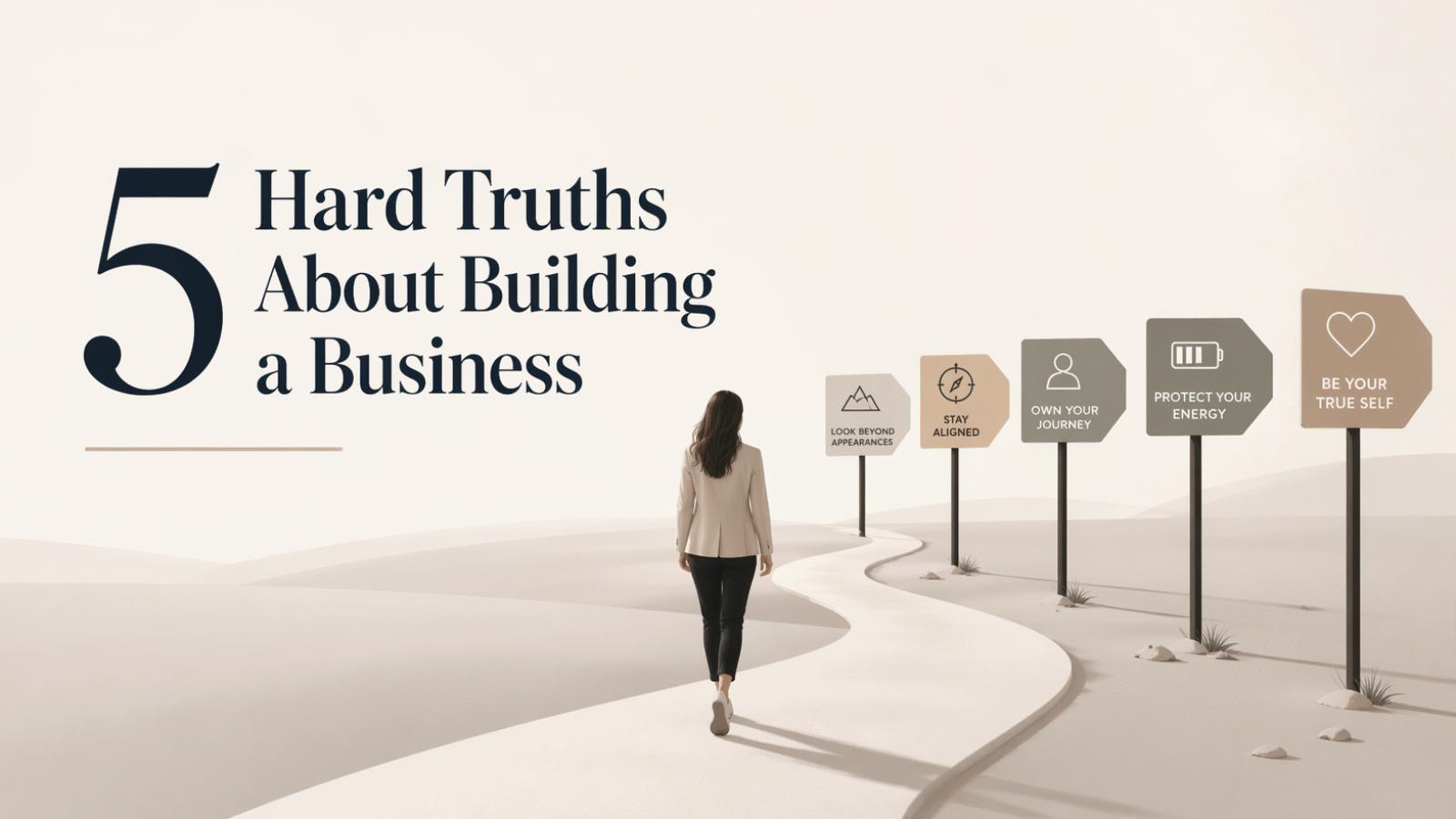
Here are the five truths I wish someone had told me on day one.
1. The Best-Looking Businesses Are Often the Most Broken

Early in my journey, I met a founder who had raised a solid seed round, leased a sleek co-working space, and posted constant wins online. Their tech stack was impressive. Their branding was flawless. Six months later, the company quietly shut down. They’ve been burning through cash for over a year with no real product-market fit.
Meanwhile, one of the most successful business owners I know operates from a modest home office, barely posts on social media, and consistently generates seven figures in revenue. No fancy office. No PR team. Just a product that works and clients who keep coming back.
The lesson? Appearances are the worst metric for success.
This is especially true in tech, where vanity metrics like follower counts, funding announcements, and flashy product launches can mask fundamental problems. What actually matters is how a business runs, not how it looks. Are operations sustainable? Is the founder healthy and fulfilled? Are clients genuinely served? These are the questions that separate businesses that last from businesses that just look good while failing.
Here’s something most people miss: your clients and team can tell if you love what you do. Enthusiasm and alignment are felt, not performed. Even the most polished pitch deck can’t fake genuine passion for the work.
Your takeaway: This week, audit one thing in your business that exists purely for appearances. A tool you’re paying for but don’t use, a commitment that drains you, or a metric you track to impress investors or LinkedIn connections. Cut it or replace it with something that actually serves your business.
2. Purpose Is the Only Thing That Keeps You in the Game

Money got me started. Purpose kept me going.
There was a stretch around month 14 when revenue was actually growing, but I was miserable. I was chasing projects that paid well but felt hollow. I’d wake up on Monday mornings with a knot in my stomach, not because the business was failing, but because it didn’t feel like mine anymore. I’d built something that looked right on paper but felt wrong in practice.
I’m not alone in this. Research shows that 65% of entrepreneurs have experienced at least one episode of severe burnout, and 22% of businesses that fail cite burnout from poor work-life balance as the primary cause. The money wasn’t the problem. The misalignment was.
This is something the tech and startup world gets dangerously wrong. The culture glorifies the grind, the “sleep when you’re dead” mentality, the obsession with scale at all costs. But the founders I’ve worked with who build sustainable businesses, the ones still standing after five, ten, fifteen years, share one trait: they’ve defined success on their own terms. Not by revenue benchmarks or Series A milestones, but by an internal compass that guides their decisions even when the external rewards dry up.
Status and perception feed the ego momentarily. They are not long-term fuel.
Your takeaway: Write down your answer to this question: “If no one could see my business, no social media, no awards, no public recognition, would I still do this work?” If the answer is no, that’s not a failure. It’s data. Start making small shifts toward alignment.
3. No One Is Coming to Save You. That’s Your Competitive Advantage.

I used to fantasize about being “discovered.” Some executive or investor would see my potential, extend the opportunity, and everything would click into place. I now realize how passive, and frankly how disempowering, that mindset was.
Here’s what actually happened instead: I started paying attention.
I noticed that one type of service offering consistently generated referrals while another stalled every time. I noticed which client relationships energized me and which ones I dreaded. I noticed which marketing channel produced results and which one I used purely out of obligation.
Success isn’t a lightning bolt. It’s pattern recognition.
If you come from a tech background, think of it like debugging. You don’t just stare at broken code and hope it fixes itself. You isolate variables, test hypotheses, and iterate. Building a business works the same way. The most successful entrepreneurs I’ve worked with are not visionaries in the cinematic sense. They’re observers. They track what works, double down on it, and systematically cut what doesn’t. That’s it. No secret formula. No magical moment. Just disciplined attention, repeated weekly.
The data supports this: according to industry research, businesses that maintain consistent analysis and adjustment of their strategies are 13 times more likely to achieve a positive ROI than those that don’t.
Your takeaway: Open a simple document or spreadsheet. Every Friday for the next month, write down three things that worked this week and one thing that didn’t. At the end of the month, look for patterns. Your next strategic move is hiding in those notes.
4. Resilience Is Not About Grinding Harder. It’s About Protecting Your Energy.

This lesson almost cost me my health.
In year one, I wore exhaustion like a badge of honor. Fourteen-hour days. Working weekends. Answering Slack messages at midnight. I told myself I was being resilient, that the pain was proof I was building something meaningful.
I wasn’t being resilient. I was burning out.
The numbers on this are staggering: 52% of entrepreneurs report burnout at least once per year, and 43% have experienced it more than once during their careers. Even more telling, entrepreneurs with higher resilience levels report 40% lower burnout symptoms, and that resilience comes not from working more, but from managing energy more strategically.
In tech especially, there’s a toxic narrative that the hardest worker wins. That you should be shipping features at 2 AM and wearing your sleep deprivation as a flex. But the most resilient founders I know share a counterintuitive habit: they are ruthless about boundaries. They know exactly where their energy creates the highest return, and they refuse to spend it anywhere else. They say no to good opportunities so they can say yes to great ones. They turn their brains off at predictable times so they can turn them on at full capacity when it matters.
You’ll know your resilience is maturing when you can no longer bring yourself to do work that falls outside your zone of impact. It’s not laziness. It’s optimization.
If you never recover, you never improve. You just get more tired.
Your takeaway: Identify one recurring task or commitment that consistently drains you without producing meaningful results. Delegate it, automate it, or eliminate it within the next two weeks. Protect that recovered energy for the work only you can do.
On the hard days, you put one foot in front of the other. Pain is temporary. All you have to do is stay in the game long enough to win.
5. Real Confidence Is Built by Becoming More of Yourself, Not More of What Others Expect

I will never do everything perfectly. But year by year, I’ve become more certain. Not of my abilities, but of my values. Of what I will tolerate and what I won’t. Of where my time goes and where it doesn’t.
That kind of confidence can’t be faked. And it’s not the brash, chest-thumping kind you see on tech Twitter or founder podcasts. It’s quieter. It’s the steady certainty that comes from making decisions aligned with who you actually are, rather than who you think the market wants you to be.
My dad has said something to me my entire life:
“Insanity is doing the same thing over and over and expecting a different result.” I’ve probably heard that a thousand times.”
My business owner Dad who succesfully built a restaurant from ground up
But it took me three years in business to understand what it actually means in practice.
Here’s my interpretation: try everything once to solve your problem. Then stop and think about what you’d do differently. Make small adjustments. Try again. This cycle of action, reflection, small pivot, and repeat is the engine behind every meaningful improvement I’ve ever made. It’s essentially the build-measure-learn loop that the best product teams swear by, applied to your entire life.
The pivots don’t have to be dramatic. Most breakthroughs come from 2% adjustments, not 180-degree turns. But you have to make them. Otherwise, you’re just cycling through the same mistakes and missing the small wins that compound over time.
And when something no longer serves you? Make the decision to part ways. Then stick to it.
Your takeaway: Choose one area of your business where you’ve been operating on autopilot. Change one small variable this week. A different approach to outreach, a new daily workflow, a shifted pricing structure. Observe what happens. Track the outcome. Adjust again.
The Bottom Line
The bravest people in business are not the ones who have it figured out. They’re not always the smartest, the most polished, or the most connected. They’re the ones willing to figure it out in real time, to show up on the days they don’t want to get out of bed, and to keep going when no one is watching.
Three years in, here’s what I know for certain: being successful, whatever that means to you, requires the courage to start, the awareness to adapt, and the honesty to build something that’s actually yours.
Now go build. There’s no perfect time, but there’s no better time than today.
If This Resonated With You
Half the battle is knowing what to focus on. The other half is having the support to actually do it.
At Execla, we pair founders and executives with highly trained Executive Assistants who take over your email, calendar, and admin ops so you can get back to the work that moves the needle. Our clients consistently reclaim 10 to 15 hours per week.
Execla founder, Kayla Deitch
Book a free session with our team and let’s talk about where your time is going and where it should be. No pressure. Just a conversation.
What’s the hardest lesson you’ve learned in business? Drop a comment below. I read every single one.