

Recap: In our previous sections, we covered why you need an executive assistant and how to hire the right one. We discussed identifying the signs of overwhelm, understanding the difference between an EA and an administrative assistant, and the complete hiring process from defining the role to making the offer. Now comes the critical part: setting your new EA up for success before and after their first day.
Most executives make a costly mistake. They hire a great EA, then throw them into the deep end with no preparation. No access to tools. No context about priorities. No clear expectations. The EA spends weeks guessing, making avoidable mistakes, and feeling lost while you wonder why they’re not performing.
Great onboarding starts before day one. This is called pre-boarding, and it’s the difference between an EA who’s effective in 30 days versus one who’s still struggling at 90 days.
Pre-Boarding and Onboarding Your Executive Assistant: Setting Them Up for Success
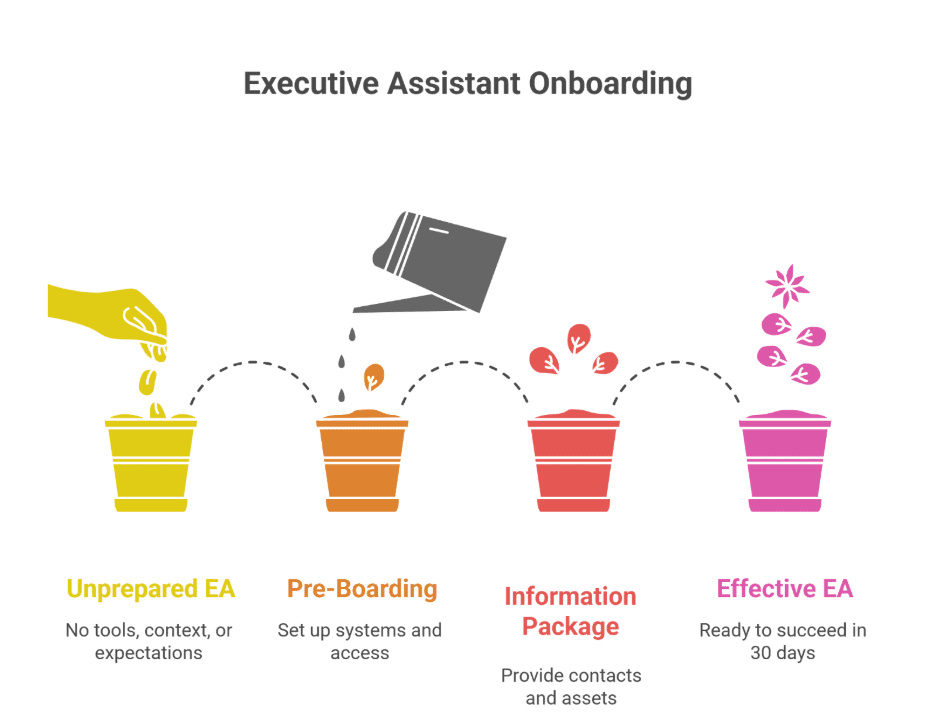
Pre-Boarding: Setting Up Your EA Before Day One
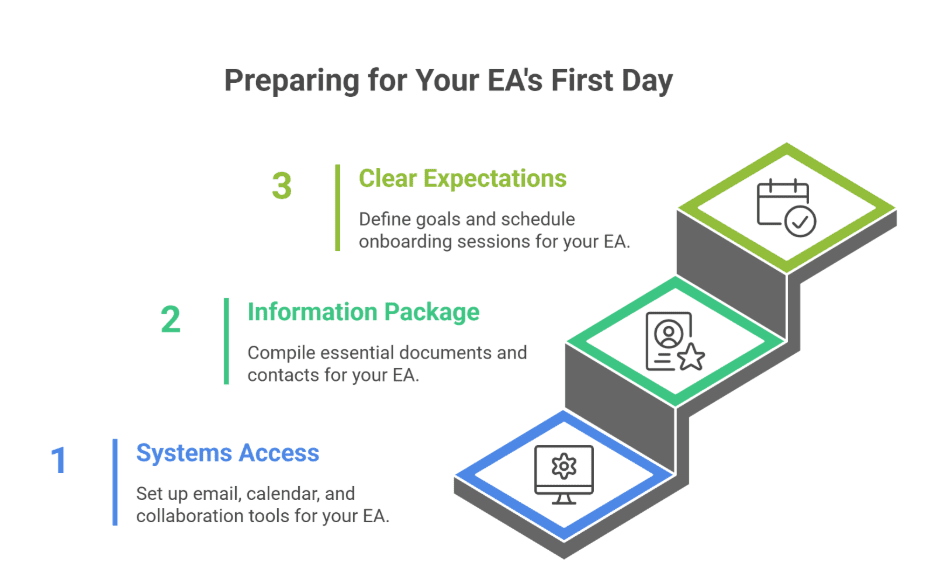
Before your EA’s first day, prepare everything they need to hit the ground running. This isn’t just practical. It sends a powerful signal: “You matter, and we’ve made space for you to succeed.”
Start with systems and access. Set up their email and calendar accounts before they arrive. Get them into your collaboration tools like Slack or Teams, your project management platforms, and your CRM. Add them to travel platforms and loyalty programs. Set up their expense and finance tool access. Nothing kills momentum like spending the first week waiting for IT to provision access.
Next, package the information and assets they need:
- Updated contact list with VIP tags so they know who matters most
- Recent agendas and decks from key meetings so they understand what you’ve been working on
- Org chart with roles explained, not just names and titles
- Company handbook and key policies they need to know
Finally, set clear expectations and schedule their first week:
- Write out what their first week will look like
- Define high-level 30-day goals so they know what success means
- Block time on your calendar for onboarding sessions because if it’s not on your calendar, it won’t happen
When your EA walks in on day one with everything ready, they know you’re serious about this partnership.
Building Your “Executive’s Bible”
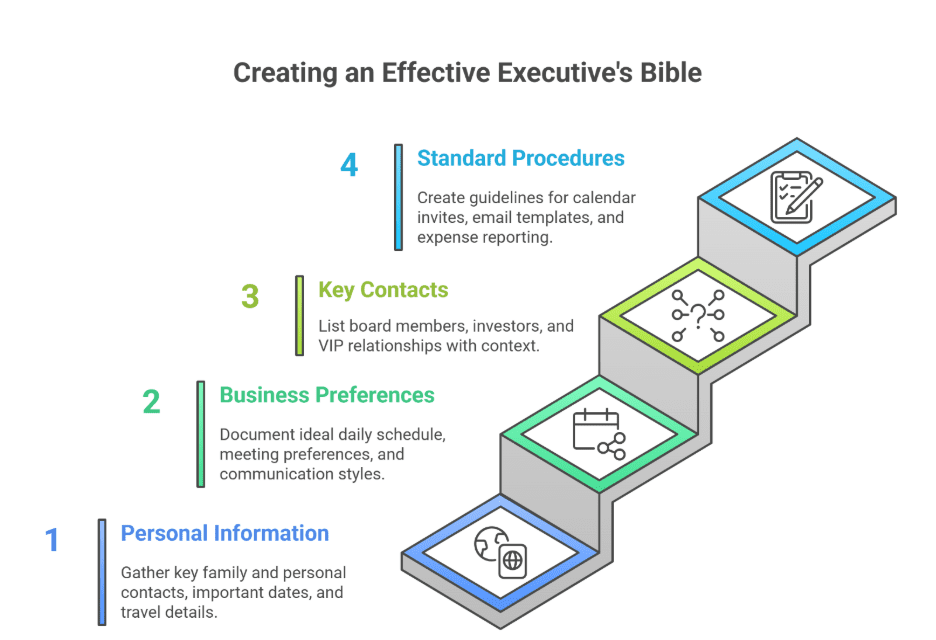
One of the most effective onboarding tools is what EA specialists call the “executive’s Bible.” It’s your instruction manual for working with you.
This document becomes your EA’s reference guide when you’re unavailable and they need to make decisions on your behalf. Think of it as your EA’s decoder ring for your professional life. The more context you front-load, the faster they can act with confidence.
Start with personal information. Include key family and personal contacts, important dates like birthdays and anniversaries, and your home and travel details with preferred providers. This helps them manage the personal logistics that would otherwise eat into your time.
Document your business preferences in detail:
- What does your ideal daily schedule look like? When are your focus times?
- Do you prefer back-to-back meetings or buffers between them?
- Are you a morning person or an afternoon person?
- What are your travel preferences for airlines, seats, hotels, and loyalty numbers?
- How do you prefer to communicate? When should they call versus text versus email versus wait?
List your key contacts with context. Board members, investors, senior leaders. Top clients, partners, and VIP relationships. Key internal stakeholders and what they’re responsible for. Your EA needs to know not just who these people are, but why they matter and how to prioritize them.
Finally, create standard operating procedures for everything:
- How do you like calendar invites formatted?
- What email templates and signature rules should they use?
- How should they prioritize incoming requests?
- What’s your expense approval and reporting process?
- How do you handle birthdays, gifts, and key events?
The clearer this document is, the better your EA will represent you and the fewer questions they’ll need to ask.
A 30-Day Onboarding Plan for Your Executive Assistant
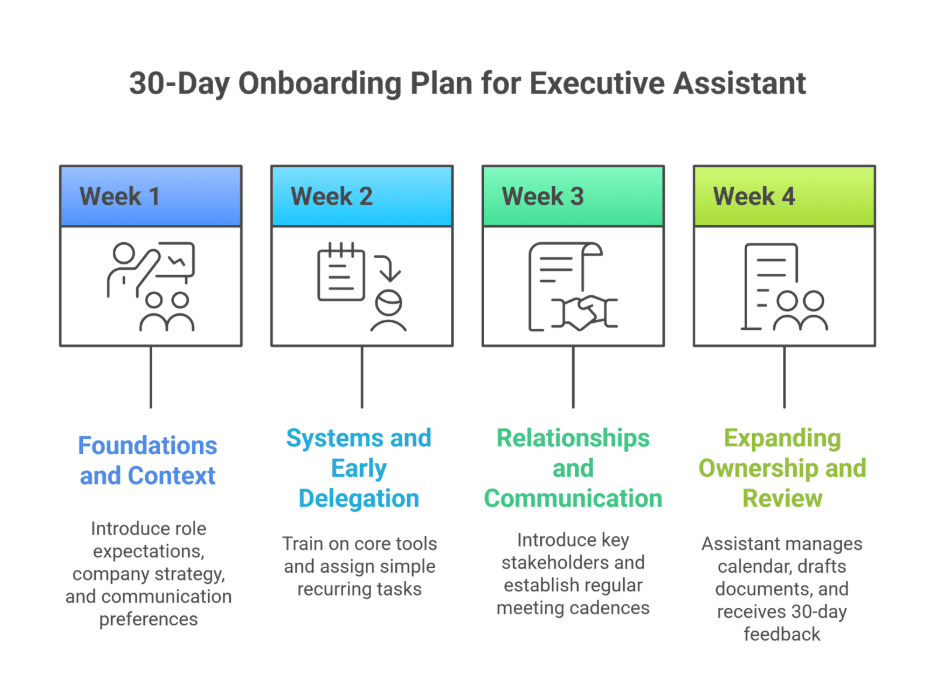
You don’t need a 40-page manual, but you do need a structured first month. EA experts recommend intensive onboarding in the first 30 days because this is when habits form and expectations get set.
Week 1: Foundations and Context
The first week is about the big picture. Focus on role expectations and success metrics so they know what they’re being measured on. Share your company story, strategy, and priorities so they understand what matters. Walk them through your typical week so they see the patterns. Clarify communication preferences and boundaries so they know when and how to reach you.
Spend time each day “thinking out loud” so your EA can understand how you make decisions. Let them shadow you in meetings. Explain why you said yes to one request and no to another. The more they understand your reasoning, the better they’ll be at making similar decisions when you’re not available.
Week 2: Systems, Processes, and Early Delegation
Now go deeper into the mechanics. Walk them through every core tool you use including your calendar, inbox, CRM, and project tools. Show them how you use each one and what matters most.
Give them simple recurring tasks they can start owning:
- Calendar blocks and focus time protection
- Follow-up reminders from meetings
- Drafting responses to routine emails
- Basic travel coordination
Review past travel itineraries and meeting plans so they see what good looks like. Give them low-risk tasks first, then review together to align on quality standards. This is how you build confidence on both sides.
Week 3: Relationships and Communication Rhythms
Shift toward the human side of the role. Start making introductions to key stakeholders, both internal and external. Give clear explanation of dynamics. Who matters most? What do they care about? What’s the history with each relationship? This context is gold for your EA.
Set up regular cadences now:
- Daily stand-ups for quick alignment
- Weekly 1:1s for deeper discussions
- Monthly review meetings to step back and assess what’s working
Ask your EA to start joining more meetings as your proxy for scheduling, logistics, and follow-up. Let people know they’re your main point of contact for coordination.
Week 4: Expanding Ownership and Feedback Loops
By week four, your EA should be owning your calendar with minimal supervision. They should be drafting more emails and documents on your behalf. They should be running checklists for travel and key meetings without you having to remind them. And ideally, they should be bringing you suggestions for improvements to your workflow.
Hold a 30-day review. What’s working? What’s confusing? What do they need more of from you? This is the moment to reinforce trust and adjust expectations before bad habits form. Be honest about what you’ve seen, both good and areas for improvement. This conversation sets the tone for your ongoing partnership.
Best Practices for Supporting a New EA
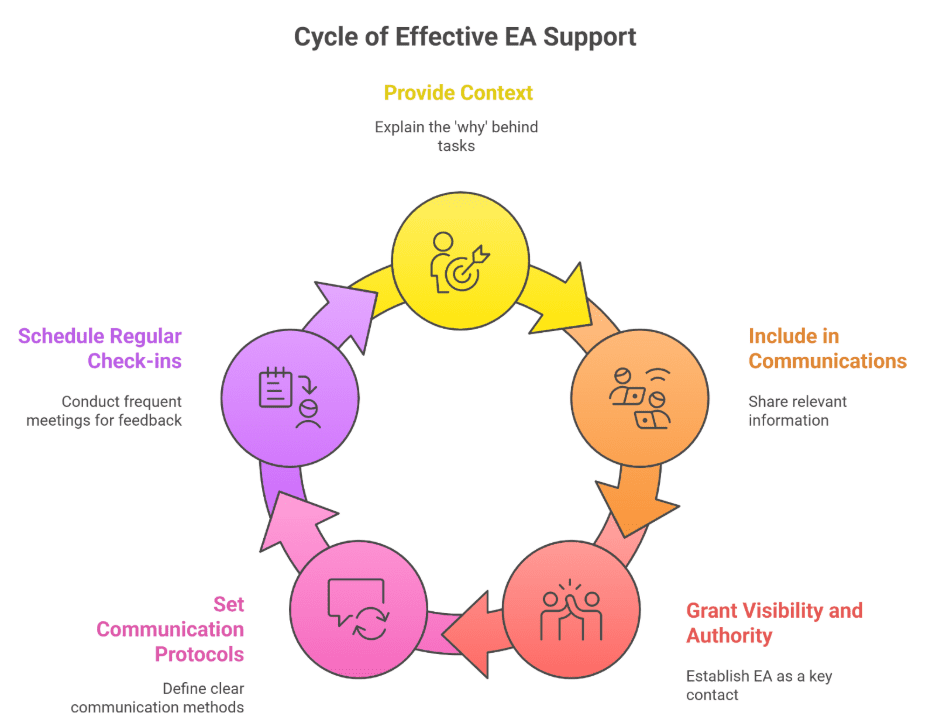
Top onboarding resources emphasize two themes: context and trust. Here’s how to put that into action.
Always provide context, not just tasks. Don’t only say, “Schedule a call with Sarah.” Add why it matters. “Sarah’s deciding whether to renew our contract, so we need this call before month-end.” The “why” lets your EA make smarter decisions later when you’re not available. It transforms them from a task-taker into a strategic partner.
Include them in communications even when there’s no immediate task. CC them on relevant email threads. They’ll learn your tone, priorities, and relationships faster by observing than by asking questions after the fact. This passive learning is incredibly valuable and costs you nothing.
Give them visibility and authority from day one. Add your EA’s contact details to your email signature. Tell people directly: “Please coordinate with [EA Name] for scheduling and logistics.” This signals they’re your primary gatekeeper and people should respect their decisions. If you don’t give them authority, people will go around them, and they’ll never be effective.
Set clear communication protocols to remove ambiguity about how to reach you:
- Phone = urgent
- Text/Slack = important
- Email = normal
- Email + text = high-priority email needing quick attention
When your EA knows the rules, they can protect your time without constantly second-guessing.
Schedule regular check-ins, especially at the beginning. Weekly 1:1s for the first month are non-negotiable. Then shift to bi-weekly or monthly as the relationship matures. Use this time to give feedback, answer questions, and make sure small issues don’t become big problems.
The Investment That Pays Forever
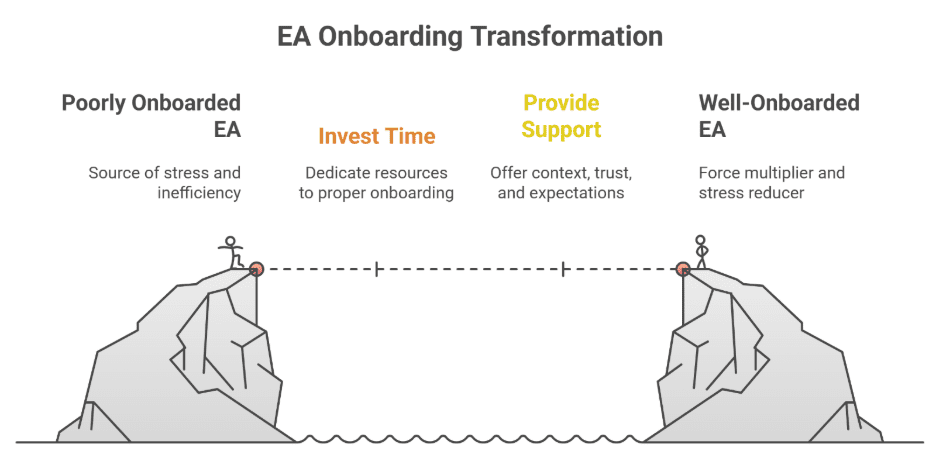
Most executives underinvest in onboarding. They’re too busy to do it properly, so they cut corners. Then they wonder why their EA isn’t performing at the level they expected.
Here’s the truth: the time you invest in the first 30 days determines the value you get for the next three years. A well-onboarded EA becomes your force multiplier. A poorly onboarded EA becomes another source of stress.
Support your EA like you would a key leadership hire, and you’ll get leadership-level impact. Give them context, trust, and clear expectations. The return on that investment is measured in hours reclaimed, stress reduced, and focus regained.
Your EA can only be as effective as the foundation you build for them. Build it right, and they’ll become the best hire you ever made.
Common Mistakes, Success Plans, and Making Your EA Partnership Last
Recap: We’ve walked through recognizing when you need an EA, the complete hiring process, and how to set them up for success through pre-boarding and structured onboarding. Now let’s address the mistakes that derail even well-intentioned executives, provide a clear roadmap for the first 90 days, and answer the questions that come up most often.
Even experienced executives fall into predictable traps when hiring and onboarding an EA. These mistakes cost time, money, and sometimes the relationship itself. The good news? They’re completely avoidable once you know what to watch for.
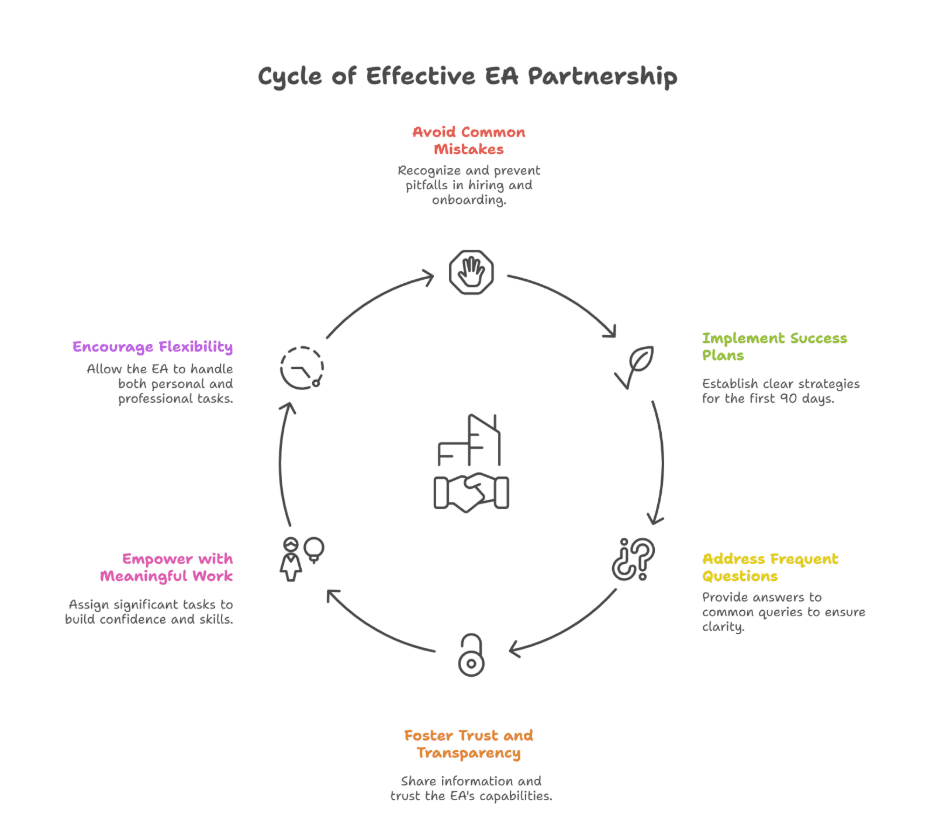
Common Mistakes to Avoid When Hiring and Onboarding an EA
“I Can Do It Faster Myself”
This is true today. It’s false over a year. Yes, showing your EA how to book your travel takes 30 minutes when you could do it in 10. But training once saves dozens of hours later. Every time you think “I’ll just do it myself,” you’re choosing short-term speed over long-term leverage. Stop trading your future time for present convenience.
Treating Onboarding as an Extended Interview
You’ve already vetted and hired this person. Stop testing them with low-level busy work to see if they’re “worthy” of real responsibility. Give them meaningful work early. Let them see the important stuff. If you don’t trust them with substance, you hired the wrong person.
Withholding Information
Your EA can’t anticipate if they don’t see the big picture. Share your strategy, your challenges, your long-term goals. Tell them what keeps you up at night. Explain why certain relationships matter and others don’t. The more context they have, the better decisions they’ll make on your behalf. Information isn’t power when it’s locked in your head. It’s power when it’s shared with someone who can act on it.
Micromanaging Every Move
Provide clear SOPs and quality standards, then step back. Review the output, not every keystroke. If you’re checking every email they draft and every calendar invite they send, you haven’t hired an assistant. You’ve hired someone to watch you work. Trust the process you’ve built and let them execute.
Overwhelming Them on Day One
Flooding someone with 47 tasks before giving them any context leads to preventable mistakes. They’ll spend the first month putting out fires instead of learning your world. Start with foundations, then layer on complexity. Speed comes from clarity, not from rushing.
Drawing Hard Lines Around “Personal” Tasks
The same organizational skills that coordinate a board meeting can manage a dentist appointment. The same attention to detail that books your business travel can handle your family vacation. Don’t artificially limit your EA’s ability to free your time because you think personal tasks are “beneath” the role. The best EA relationships blur these lines because executives realize their time is their time, whether it’s spent at work or at home.
Avoiding these pitfalls makes your investment in hiring and onboarding an EA truly pay off.
Sample 30-60-90 Day Success Plan
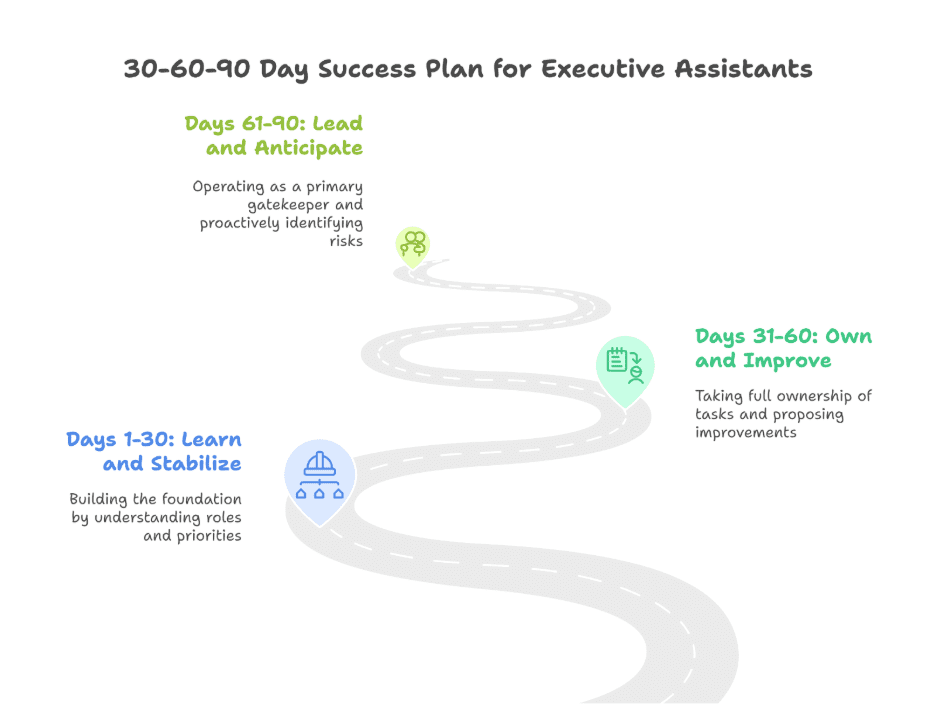
Here’s a simple framework you can adapt to your situation. Use this as a living document you review together during your regular 1:1s.
Days 1-30: Learn and Stabilize
The first month is about building the foundation. Your EA should understand your role, your company, and your priorities. They should start managing your calendar and inbox with guidance, not independently yet. Give them small recurring tasks and checklists they can own completely. Have them document your preferences in the executive’s Bible as they learn.
Success looks like: They can explain your top three priorities to someone else. They know who the VIPs are and why. They’ve taken ownership of at least three recurring tasks that no longer require your attention.
Days 31-60: Own and Improve
By month two, they should fully own your calendar and most inbox triage. They should run travel end-to-end with only final approval from you. They should prepare briefings for key meetings without you asking. And importantly, they should start proposing improvements to your workflows and routines.
Success looks like: You’re no longer checking your calendar before saying yes to meetings. Your inbox isn’t stressing you out. You walk into meetings prepared. And your EA is bringing you ideas, not just executing yours.
Days 61-90: Lead and Anticipate
By month three, your EA should operate as the primary gatekeeper for your time. They should surface risks and opportunities proactively, things you might not have seen coming. They should take on small projects or operational responsibilities beyond pure admin. And they should drive their own development plan with you, identifying what they want to learn and grow into.
Success looks like: People instinctively go to your EA first, not you, for scheduling and logistics. Your EA flags potential conflicts before they become problems. You find yourself saying “I hadn’t thought of that” when they bring you insights. The relationship feels like a true partnership.
FAQs About Hiring and Onboarding an Executive Assistant
When is the right time to hire an executive assistant?
You’re ready when your schedule, email, and admin work consistently pull you away from strategy and leadership, and when you can clearly define what to delegate. If you can list at least 15 to 20 hours of recurring tasks per week, an EA will likely create a strong return on investment. The math is simple: if your time is worth $500 per hour and you’re spending 15 hours on $50-per-hour work, you’re losing $6,750 in value every single week.
Should I hire a virtual assistant or an executive assistant?
Virtual assistants typically support multiple clients and focus on discrete, task-based work. Executive assistants are dedicated to you, or to a small number of leaders. They develop deep knowledge of your business and handle higher-stakes responsibilities and decisions. If you need someone to knock out a list of tasks, hire a VA. If you need a long-term strategic partner who becomes an extension of you, hire an EA.
How long does it usually take to hire a great EA?
If you run the search yourself, expect 6 to 12 weeks from posting to start date. Specialized EA staffing firms can often reduce that to 3 to 6 weeks because they maintain networks of pre-vetted candidates. Don’t rush. Choosing the wrong EA often creates more work than having no EA at all. A bad hire costs you three to six months of wasted time, energy, and money when you factor in hiring, training, realizing it’s not working, separating, and starting over.
What should I include in my executive assistant onboarding checklist?
Strong EA onboarding checklists usually cover tech setup including email, calendar, tools, and phones. They include access to all critical systems like your CRM, finance tools, HR platforms, and travel booking systems. They provide contact lists and org charts with context, not just names. They include your executive’s Bible with preferences, SOPs, and key relationships documented. They outline clear 30-60-90 day goals and establish regular check-ins and feedback loops from day one.
How much information is “too much” to share with my EA?
EAs can’t be effective without context. Share broadly, especially around strategy, upcoming decisions, and sensitive timelines. Set clear boundaries on what must remain confidential, but default toward sharing more, not less, so they can anticipate needs rather than react. If you find yourself thinking “Should I tell them about this?” the answer is almost always yes. Your EA should know things before other people in your organization do because they need to help you prepare for what’s coming.
What if my EA makes mistakes early on?
Some missteps are inevitable as they learn your style. Focus on patterns, not isolated errors. If they learn quickly, adjust their approach, and communicate openly, that’s a good sign. If the same mistakes repeat despite clear feedback and resources, it may be a fit issue. Give it 60 to 90 days before making any major decisions. Most EAs hit their stride somewhere between month two and month four.
How do I keep my EA engaged long-term?
Treat your EA as a key professional partner. Share your objectives and invite their input. Offer growth opportunities like special projects, operations work, or chief-of-staff-type responsibilities. Recognize their wins publicly and let other people know how much you value them. Include them in offsites or key meetings where appropriate so they feel like part of the leadership team, not just support staff. Engaged EAs stay longer and deliver exponentially more value.
Turning Your EA into a Strategic Partner
Hiring and onboarding an EA isn’t just about getting “help with admin.” Done well, it’s about building a trusted partnership that changes how you work, what you focus on, and how quickly you move.
By following this complete guide, defining the role clearly, hiring thoughtfully, and investing in a structured 30-60-90 day onboarding, you dramatically increase the odds that your new EA will become one of the most important relationships in your professional life.
The executives who get this right talk about their EAs the way athletes talk about their coaches. They’re not just helpful. They’re essential. They don’t just save time. They unlock entirely new levels of performance.
Treat the process with the same seriousness as hiring a senior leader, and you’ll unlock leverage that compounds for years. Your EA won’t just make your life easier. They’ll make your impact bigger, your stress lower, and your focus sharper.
That’s not admin support. That’s transformation. And it starts with getting the hiring and onboarding right from day one.